This digital museum chronicles the formative years of Dow Medical College from its establishment in 1945 through the mid-1960s. Through archival photographs, documents, and narratives, we preserve the institution's academic legacy, student activism, and contributions to Pakistan's medical education.
Historical documents & photos
Generations of medical professionals
From 1945 to present
Academic & professional excellence
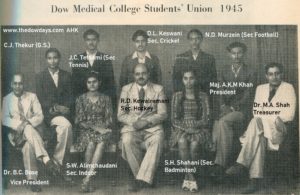
Dow Medical College Karachi was established on 10th of December 1945. This is the first Dow Medical College Student's Union; It started a tradition that lasted almost 35 years when Dow always had a Students' Union representing the interests of the students to the Administration, Civil Hospital, University of Bombay initially and later University of Karachi and to the Provisional and Federal Government. The Union was elected democratically. It also got involved in National politics when it invited political leaders to address the students. It organized student social and literary functions and graduation ceremonies every year giving awards to the students graduating with distinctions. It fought for establishing amenities like library and cafeterias in the college. It intervened aggressively when there were allegations of sexual harassment against the teachers. It dealt with University when students felt that they were not prepared for the exams or when they had staged a walk out for unfair questions in the exam. They arranged books for deserving students, arranged buses for transportation of students from outlying areas. All this changed when the political atmosphere changed in the country in early 1980's and the Federal Government felt it could no longer risk grass root movements from politically conscious students. Our class of 1977 was lucky to have witnessed every one of these activities of the DMCSU in the 1970's throughout our stay. Note the composition of the Union before Partition. There are only 2 Muslim names. Also note that sports committees dominate and ladies are represented
The first annual magazine of Dow Medical College, published in 1950, marked the birth of a tradition that shaped the cultural and academic identity of the institution for decades. This inaugural issue captured student life, faculty perspectives, and the early spirit of a college that had been founded only a few years earlier. The magazine later continued under the well-known title "Dowlite", becoming the primary platform through which students documented achievements, activities, and evolving campus life throughout the 1950s and beyond.
The inaugural magazine featured contributions from early academic figures and pioneering students. Based on the surviving scanned pages, the following individuals were part of the publication leadership:

This rare photograph captures the Managing Committee of the Dow Medical College Union with the legendary Sir Alexander Fleming, the discoverer of penicillin, during his visit to Dow Medical College on 10 April 1951. The moment reflects a remarkable chapter in the institution's early history when global scientific leaders engaged directly with Dow's academic community. Taken in front of the old DMC building, the image showcases faculty members and student representatives seated alongside Sir Alexander Fleming and college leadership. It stands as one of the most iconic photographs from Dow's formative decade.
Sitting L. to R.
Standing L. to R.

This page from the Dow Medical College Magazine documents a significant episode of student activism in 1956, when students undertook a continuous hunger strike to press their demands. The images capture student leaders and participants during the protest, reflecting the intensity and discipline of the movement. Contemporary commentary notes the deliberate choice to endure hunger silently, underscoring the moral seriousness with which the students approached their cause. The episode culminated in assurances from Mr. Suharwardy, whose intervention was recorded as decisive, reinforcing the belief among students that their grievances had been acknowledged. This hunger strike stands as an important illustration of Dow Medical College's long tradition of civic engagement and principled student leadership during the formative years of Pakistan

This page from the Dow Medical College Magazine captures the scale and resolve of the Medicos' Struggle of 1956, a defining chapter in student-led advocacy at Dow. Faced with unresolved academic and financial concerns—particularly affecting students of limited means—medical students organized mass demonstrations, deputations, and ultimately strikes when other avenues failed. The photographs document organized marches through the streets of Karachi, with students carrying banners demanding fair scholarships and institutional reforms. The movement reflected a disciplined, collective response rooted in social responsibility and moral conviction, reinforcing Dow Medical College's longstanding role as a center of civic consciousness and principled resistance during Pakistan's early years.

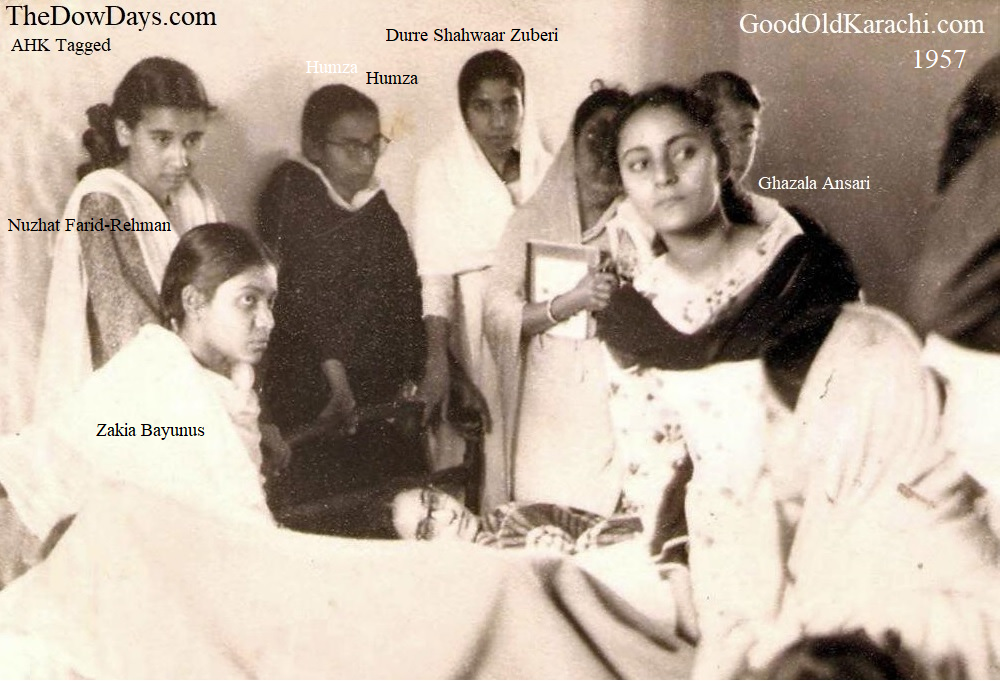
The Girl Students' Hunger Strike of 1957 was a significant episode in the history of Dow Medical College, reflecting organized student advocacy by women at a critical moment in Pakistan's early post-independence period. Female students collectively undertook a hunger strike to press a series of demands, including improved hostel facilities, enhancement of the lending library, reduction of the passing threshold from 60% to 50%, and other academic and welfare-related concerns.
The strike drew national attention and led to the visit of Prime Minister of Pakistan, Marhoom Huseyn Shaheed Suhrawardy, who met with the students on campus. Suhrawardy reassured the striking students and appealed to them to call off the protest. A barrister and prominent politician, he served as Prime Minister from 1956 to 1957 and is regarded as one of Pakistan's founding statesmen.
The accompanying photograph documents women students involved in the strike, including Dr. Ghazala Ansari, Nuzhat Farid-Rehman, Zakia Bayunus, Durre Shahwaar Zuberi, and Humza, capturing a moment of solidarity and resolve. The image stands as a rare visual record of women's collective action within medical education during the 1950s.
This event remains an early and important example of women students asserting their academic and institutional rights at Dow Medical College. Preserved in the DUHS Digital Museum, it highlights both student agency and the engagement of national leadership with campus life during a formative period in the university's history.
Photo courtesy of Dr. Ghazala Ansari (DMC Class of 1960), niece of the then Principal of Dow Medical College, Marhoom Abdul Waheed
.
This record is taken from an article published in an early Dow Medical College publication, which formally recognized the role played by Dow graduates and faculty during the Pakistan–India War of September 1965. The article acknowledged the contribution of medical professionals who served the nation during a period of armed conflict, providing essential medical care and support. The Dow graduates identified in the publication as having served during the 1965 War are:

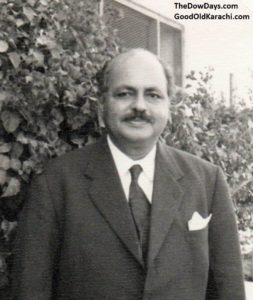
Principal of Dow Medical College (1945-1953 & 1954-1955). His leadership spanned the formative decade of the college's early growth.
Late Lt. Col. Aziz K. M. Khan served as the second Principal of Dow Medical College, holding office from December 31, 1945 to January 25, 1953, and again from September 1, 1954 to May 25, 1955. His leadership spanned the formative decade of the college's early growth, immediately following its establishment, guiding Dow Medical College through its structural, academic, and cultural shaping years. A respected clinician, administrator, and mentor, Lt. Col. Aziz K. M. Khan was instrumental in developing Dow's academic standards, faculty strength, and student culture during a time when medical education in Pakistan was still taking root. In the 1980s, he tragically suffered a sudden death during the First Symposium held at Dow Medical College, collapsing in the presence of fellow doctors and students. He was attending the event as the Chief Guest, symbolizing his lasting connection with the institution he helped build. His contributions, leadership, and dedication to advancing medical education at Dow remain a significant part of the university's heritage. The 1950 inaugural magazine also features his name as Principal, preserving his role in the earliest documented traditions of the college.

Principal of Dow Medical College (1955-1969). One of the longest-serving principals with a tenure spanning fourteen years.
Professor Mahmud Ali Shah served as Principal of Dow Medical College from 26 May 1955 to 29 September 1969, making him one of the longest-serving principals in the institution's history, with a tenure spanning fourteen years. An accomplished ophthalmologist, he held the qualifications M.S., FACS, and FICS, and was widely respected for his academic rigor, administrative stability, and commitment to medical education. His tenure coincided with a crucial period of institutional consolidation and growth at Dow Medical College. Under his leadership, the college strengthened its academic standards, expanded clinical teaching, and reinforced its reputation as a leading center for medical education in Pakistan. Professor Mahmud Ali Shah's long and steady stewardship left a lasting imprint on Dow's academic culture and governance, shaping generations of physicians during the mid-twentieth century.

A towering figure in subcontinental medicine, distinguished by excellence in surgery and pioneering medical pedagogy.
Dr. Muhammad Abdul Hameed Siddiqi (1902–1976) was a towering figure in subcontinental medicine, distinguished by his excellence in surgery, pioneering efforts in medical pedagogy, and critical roles in national policy and institution building. Born in UP, India, he was an exceptionally accomplished student, graduating from King George Medical College (KGMC) in Lucknow in 1928 and becoming the first graduate to receive a Master of Surgery (MS) from Lucknow University in 1930. He attained the FRCS and DLO from England in 1932, followed by a Gold Medal from the Academy of Sciences of India in 1936. His commitment to structured education was demonstrated by his five-volume Atlas of Anatomy and Operative Surgery and his establishment of dedicated anatomy and surgery museums at KGMC, King Edward Medical College (KEMC) Lahore, and the College of Physicians and Surgeons Pakistan (CPSP).
Dr. Siddiqi's influence extended to high-level governance, where he served as a member of the Bhore Commission in 1946 and as Member Secretary for the planning of the All India Institute of Medical Sciences (AIIMS) in 1947. Following Partition, he relocated to Pakistan, serving as the Inspector General of Civil Hospitals of Punjab and Professor of Operative Surgery at KEMC. From 1953 until his retirement in 1975, he was the Professor of Surgery at Dow Medical College (DMC) in Karachi, defining the institution's surgical standards for over two decades. He was also a founding member of the College of Physicians and Surgeons Pakistan (CPSP), and held national posts such as Vice President of the Pakistan Medical & Dental Council (PM & DC) and Project Director of PIMS Islamabad. He was widely regarded as a brilliant teacher, strict administrator, and eloquent speaker, dedicated to medical instruction until his death in 1976 while traveling for a teaching assignment.
Late Lt. Col. Aziz K. M. Khan served as the second Principal of Dow Medical College, holding office from December 31, 1945 to January 25, 1953, and again from September 1, 1954 to May 25, 1955.
His leadership spanned the formative decade of the college's early growth, immediately following its establishment, guiding Dow Medical College through its structural, academic, and cultural shaping years.

Late Lt. Col. Sher Muhammad Khan Mallick was one of the early pillars of Dow Medical College, remembered for his disciplined leadership, academic integrity, and his deep commitment to strengthening medical education in the newly founded Pakistan.
A senior officer and medical professional, Lt. Col. Mallick brought with him the precision of military service and the compassion of a clinician.

Dow Medical College Students' Union with H. E. the Governor-General Ghulam Mohamed.
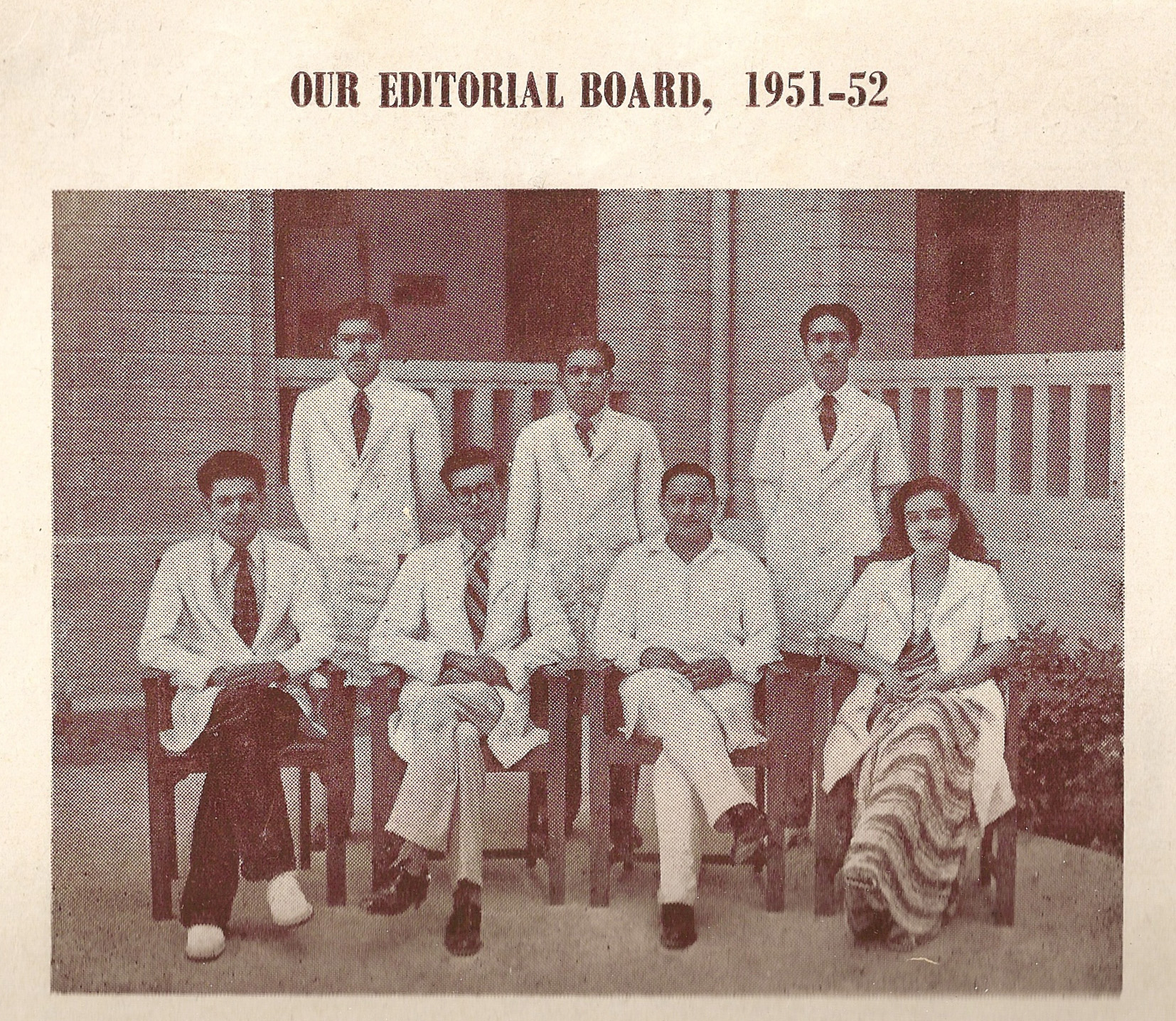
One of the earliest formally structured student editorial teams at Dow Medical College.

The 1954 fete is remembered as among the grandest social events in Karachi during the early 1950s.

One of the earliest cohorts of women athletes emerging from the institution.

Visit to Pediatric Ward at Dow Medical College and Civil Hospital Karachi.

Informal moment in student life, capturing classmates in a setting removed from academic environment.
Alumni, Marketing and Communications,
1st Floor old IBBPS Building, Ojha Campus,
Dow University of Health Sciences, Karachi, Pakistan
021-387711111 Ext 3478